Fewer denials. Cleaner GG coding. One app.
LINDERA turns a two-minute smartphone walk test into a defensible, CPT-aligned fall risk assessment — so what your therapists document matches what your billing team needs to get paid.

Proven in Europe - AI since 2017 - With any Smartphone
The problem
OASIS M1840, MDS Section GG missaligned
When OASIS M1840, MDS Section GG, and the therapist's narrative disagree on the same resident on the same day, payers deny, audits expand, and revenue leaks.
M1840 vs. GG-item inconsistency: denial cause
Close the CPT Gap
LINDERA closes that gap. One mobility analysis. One set of objective numbers. Mapped to every code your team has to defend.

How it works
One app. Three steps. Two minutes.
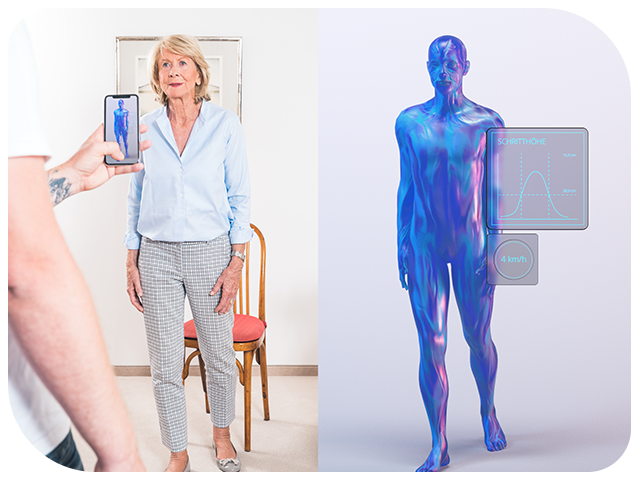
- The therapist records a 10-foot walk on a standard smartphone or tablet.
- LINDERA's AI tracks 21 skeletal landmarks, scores 18 mobility parameters, and benchmarks the resident against age-matched norms.
- Results sync into the EHR — already mapped to the relevant CPT, GG, and OASIS fields.
No wearables. No depth cameras. No mats. The phone is the device.

CPT code mapping
Built around the codes your therapists actually bill.
LINDERA outputs are pre-mapped to the codes that drive post-acute therapy revenue:
- 97161 – 97163 — PT evaluation, low / moderate / high complexity
- 97165 – 97167 — OT evaluation, low / moderate / high complexity
- 97750 — Physical performance test or measurement
- 97755 — Assistive technology assessment
- G-codes and GG items anchoring SNF PDPM CMG and home health PDGM mix
Every output ties an objective number — gait speed, step-length symmetry, sway envelope, dynamic balance, dual-task cost — to the documentation field a payer reads in audit. Therapists stop translating clinical observation into payer language. The app does that work.

Clinical validation
100% clinically validated. Not "AI-assisted" — clinically tested.
- Validated against GAITRite, the gold standard for gait analysis.
- Published in JMIR Aging (peer-reviewed, open access).
- Deployed across 600+ care sites in Europe.
- CE-marked Class IIa medical device.
- HIPAA-ready architecture for US deployment.
In published cohorts (in Review at BMC Geriatrics), sites using LINDERA reduced falls by 27% within six months and shortened mobility assessment time by roughly 65%.

What therapy leaders get back
Where the dollars and the hours actually move.
- Denial reduction. Consistent GG, OASIS, and CPT coding from one objective source. No more "M1840 says one thing, GG says another."
- Therapist throughput. A two-minute objective assessment replaces a ten- to fifteen-minute manual gait observation.
- Star ratings and quality measures. Individualized fall-risk recommendations that update as the resident changes — not generic checklists.
- Reimbursement integrity. Defensible documentation for PDPM CMG, PDGM, and home health LUPA thresholds.
- Audit readiness. Time-stamped, video-anchored, payer-mapped — the kind of trail that ends an audit fast.
Most therapy partners see net-positive economics inside the first quarter.

Built for these settings
- Skilled nursing facilities — fall risk is near-universal; LINDERA gives each resident an individualized plan that updates over time, instead of a one-time score.
- Assisted living — early identification of decline, before a fall forces a higher level of care.
- Memory care — gait and dual-task metrics that catch cognitive-motor decline that observation alone misses.
- Home health — close the OASIS-to-therapy-note gap that drives denials.

Pricing
Modular. Per bed. Per month. No hardware. No per-assessment fees.
- Core Mobility Analysis — $5 per bed per month
- Part B Therapy Module (CPT mapping, eval-to-bill workflow) — $3 per bed per month
- Part A SNF Module (GG-item alignment, MDS sync) — $5 per bed per month
Bundle as you need them.

Proof in your own data
See your denial pattern in your own claims.
Send us 30 days of redacted denial codes. We will show you how many are mobility-documentation driven — and what LINDERA changes about that number.