New research from Nature Medicine reveals: Generic AI chatbots fail in healthcare delivery. The solution? Objective, specialized AI systems like LINDERA's gait analysis.
The Promise and Reality of ChatGPT in Healthcare
Artificial intelligence is revolutionizing medicine – or so the promise of recent years suggested. ChatGPT passes medical licensing exams with top scores, generates clinical notes in record time, and answers patient questions with apparent competence. Hospitals and care facilities worldwide are experimenting with AI chatbots as first points of contact for patients.
But a groundbreaking study from the University of Oxford, published in Nature Medicine (February 2026), paints a sobering picture: When real people use ChatGPT for medical decisions, the system fails.
The Oxford Study: When AI Brilliance Meets Human Reality
Study Design
1,298 participants in the United Kingdom were randomized into four groups:
- 3 Test Groups: Using GPT-4o, Llama 3, or Command R+ for medical self-assessment
- 1 Control Group: Using traditional resources (internet, NHS website)
Each participant received one of 10 realistic medical scenarios – from sudden headaches to bloody diarrhea.
Task: Identify correct diagnosis + assess urgency (self-care to emergency ambulance).
The Shocking Results
| Metric |
ChatGPT Alone |
Human + ChatGPT |
Control Group |
| Correct Diagnosis |
94.9% |
34.5% |
35-40% |
| Correct Triage |
56.3% |
44.2% |
43% |
The central finding: Humans with AI assistance performed no better than without AI – sometimes even worse.
Why ChatGPT Fails in Practice: The 3 Fatal Flaws
1. The Communication Problem
What the study showed:
- In 53% of cases, users provided incomplete information to the chatbot
- Patients don't know which symptoms are relevant
- LLMs asked too few follow-up questions
Real-world example from the study: Two users with identical symptoms of subarachnoid hemorrhage received contradictory recommendations:
- User A: "Lie down in a dark room"
- User B: "Call emergency services immediately" ✓ (correct)
The consequence: Text-based AI is only as good as its input – and laypeople are unreliable data providers.
2. The Trust Problem
What the study showed:
- ChatGPT generated an average of 2.21 possible diagnoses per case
- Only 34% were correct
- Users couldn't distinguish between right and wrong suggestions
The consequence: Even when ChatGPT provides the correct answer, it's frequently ignored or misinterpreted.
3. The Consistency Problem
What the study showed:
- Identical symptom descriptions led to different recommendations
- Tendency to underestimate urgency
- Contextual errors (e.g., Australian emergency number for UK patients)
The consequence: Unpredictable AI behavior systematically undermines user trust.
LINDERA's Answer: Objective. Specialized. Evidence-Based.
The Fundamental Difference
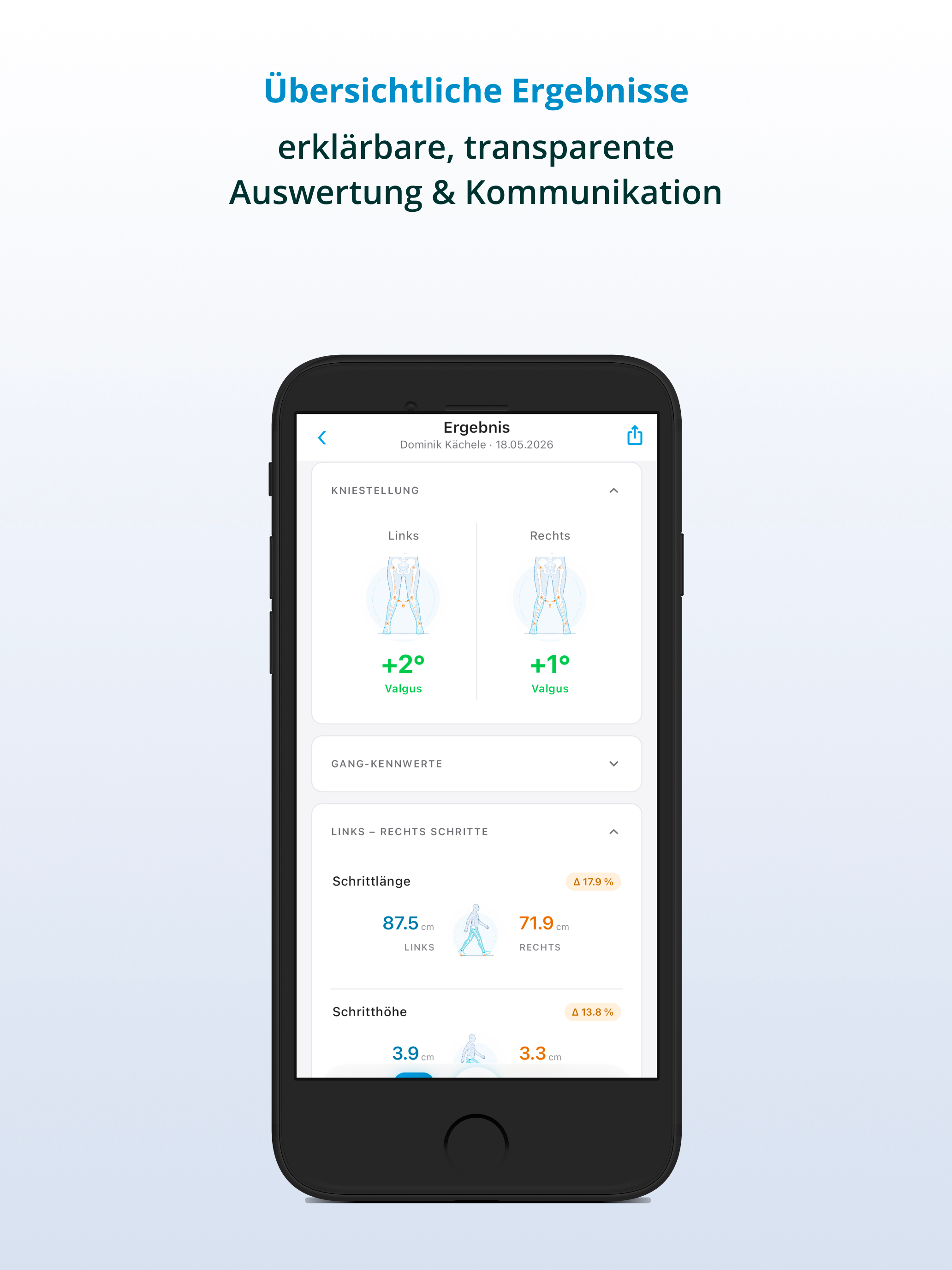
While ChatGPT relies on subjective text descriptions, LINDERA uses objective movement data.
| Aspect |
Text-based AI (ChatGPT) |
LINDERA Gait Analysis |
| Data Source |
Subjective symptom description |
Objective gait parameters (video) |
| User Effort |
Active interaction required |
Passive: 10-second video |
| Error Susceptibility |
High (communication barrier) |
Low (automated measurement) |
| Output |
Multiple possible diagnoses |
Clear risk traffic light + actions |
| Validation |
Benchmarks ≠ Real-world |
Validated in care facilities |
How LINDERA Solves the 3 Critical Flaws
Solution 1: Objective Data = No Misunderstandings
Oxford Problem: Patients describe symptoms incompletely or irrelevantly.
LINDERA Solution:
- Smartphone camera captures gait in 30 seconds
- AI analyzes all relevant movement parameters automatically
- No interpretation by laypeople required
Result: Objective, reproducible data – independent of language barriers or medical knowledge.
Solution 2: Clear Action Recommendations Instead of Diagnosis Lists
Oxford Problem: Users can't choose between 2+ AI suggestions.
LINDERA Solution:
- Clinical-validated Traffic Light System:
- 🟢 Green (Moderate risk: falls expected within 24 months)
- 🟡 Yellow (Elevated risk: fall expected within 12 months)
- 🔴 Red (High risk: falls expected within 6 months)
- Concrete action recommendations (e.g., "Initiate physiotherapy")
- Diagnostic support for professionals – not self-diagnosis for patients
Result: No overwhelming multiple-choice diagnostics.
Solution 3: Specialized AI Instead of Generalist Chatbot
Oxford Problem: ChatGPT is trained for everything, specialized in nothing.
LINDERA Solution:
- Domain-specific AI: Exclusively trained on gait analysis & fall risk
- Validated on 100,000+ gait videos from real care settings
- Continuous learning through expert feedback
Result: Consistent, reliable assessments instead of "diagnostic roulette."
The Clinical Evidence Standard: What Distinguishes LINDERA from ChatGPT
Oxford Study: Benchmarks Are Misleading
Researchers also tested ChatGPT on medical exam questions (MedQA):
- Benchmark Score: 60-80% correct
- Real-World Score with Users: 20-35% correct
Authors' Conclusion:
"Standard benchmarks for medical knowledge and simulated patient interactions do not predict the failures we find with human participants."
LINDERA: Real-World Validation First
LINDERA wasn't tested on theoretical questions, but in:
- Nursing Homes: Daily fall risk assessment
- Hospitals: Post-operative mobility evaluation
- Rehabilitation Facilities: Progress monitoring for neurological patients
Result: Optimized for practical usability from day one – not for passing exams.
What This Means for Digitalization in Care and Medicine
The Oxford Lessons for Decision-Makers
- Not All AI Is Created Equal
- Generic chatbots ≠ medical specialist systems
- Domain specialization determines success
- User-Centricity Is Critical
- Passive assessments > active interactions
- Minimize cognitive load
- Validation Must Be Real
- Lab performance ≠ everyday performance
- Only real users in real settings provide evidence
Practical Implications for Your Facility
For Nursing Homes
Instead of: "Mrs. Smith, how are you feeling today?" (subjective, inconsistent)
With LINDERA: 30-second gait video → traffic light result → structured action plan
Advantage: Documentable, objective, legally compliant.
For Hospitals
Instead of: Time-consuming manual assessments (Timed Up & Go, etc.)
With LINDERA: Automated capture during every hallway walk
Advantage: Continuous monitoring without additional effort.
For Payers
Instead of: Reactive care after falls (expensive)
With LINDERA: Preventive intervention at yellow signal (cost-effective)
ROI: Each prevented fall saves avg. $18,000-24,000 in treatment costs.