Blog
AI
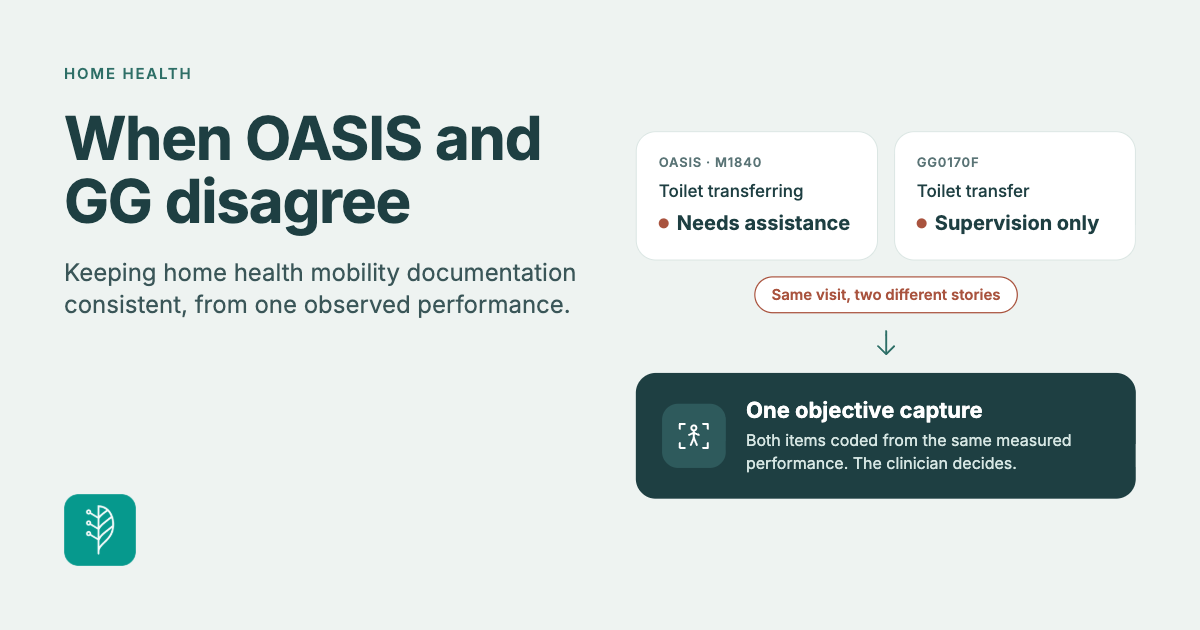

OASIS mobility items (M1840, M1850, M1860) and the GG mobility items describe the same patient's function in two different ways. When they contradict each other on the same assessment, reviewers question the record, and payment for the period is at risk. Agencies keep them consistent by scoring both from one observed, measured performance and by documenting why any difference is legitimate.
Ask any home health QA nurse where audits go wrong and you will hear the same story. The start-of-care OASIS says the patient needs help getting on and off the toilet. The GG section says she does it with supervision only. The PT evaluation, written the next day, describes a third picture. Each clinician scored honestly. Together, the record contradicts itself.
OASIS carries two item sets that both describe mobility. They were built for different purposes, and both matter to your agency.
|
M items (Section G) |
GG items (Section GG) |
|
|---|---|---|
|
Mobility items |
M1840 Toilet transferring, M1850 Transferring, M1860 Ambulation/locomotion |
GG0170 Mobility, e.g. sit to stand, chair/bed-to-chair transfer, toilet transfer, walking 10, 50 and 150 feet |
|
What the clinician rates |
The patient's ability to perform the activity safely on the day of assessment |
The patient's usual performance, on a six-level scale from independent to dependent |
|
Where it counts |
PDGM functional impairment level, together with M1800 to M1830 and M1033, so it drives case-mix and payment |
The Discharge Function Score in the Home Health Quality Reporting Program and the expanded Home Health Value-Based Purchasing Model |
In short: the M items shape what you are paid for this period. The GG items shape how your quality is scored, and through value-based purchasing, what you are paid later. Both sit on the same assessment in OASIS-E2, the current version since April 1, 2026.
Some differences are legitimate. The two item sets use different definitions (ability versus usual performance), different scales and different activities. A patient may be able to walk 150 feet safely with a walker but usually walks only from bed to bathroom. Most contradictions, though, come from how the assessment is done:
The result is a chart in which each entry is defensible on its own and the set is not.
Payment. Reviewers compare the OASIS functional items with the GG items, the therapy evaluation and the visit notes. In a 9-case payer audit batch we reviewed with a US home health partner, the OASIS toilet-transfer item (M1840) contradicted the GG toilet-transfer and walking items and the PT/OT evaluation in 6 of 9 cases. In every flagged case, the reviewer re-scored M1840 to a less impaired level. That lowered the functional impairment level, the case-mix group and the payment. It was the most frequent finding in the batch, ahead of timing, diagnosis and admission-source errors.
Quality scores. The Discharge Function Score compares each patient's discharge GG scores with an expected score that is risk-adjusted from start-of-care data. GG scoring that is careless at admission distorts the measure your agency is publicly reported on.
Time. Every contradiction caught before billing means a QA review, a call to the clinician and often a corrected assessment. Every contradiction caught after billing means an appeal, with deadlines that are easy to miss.
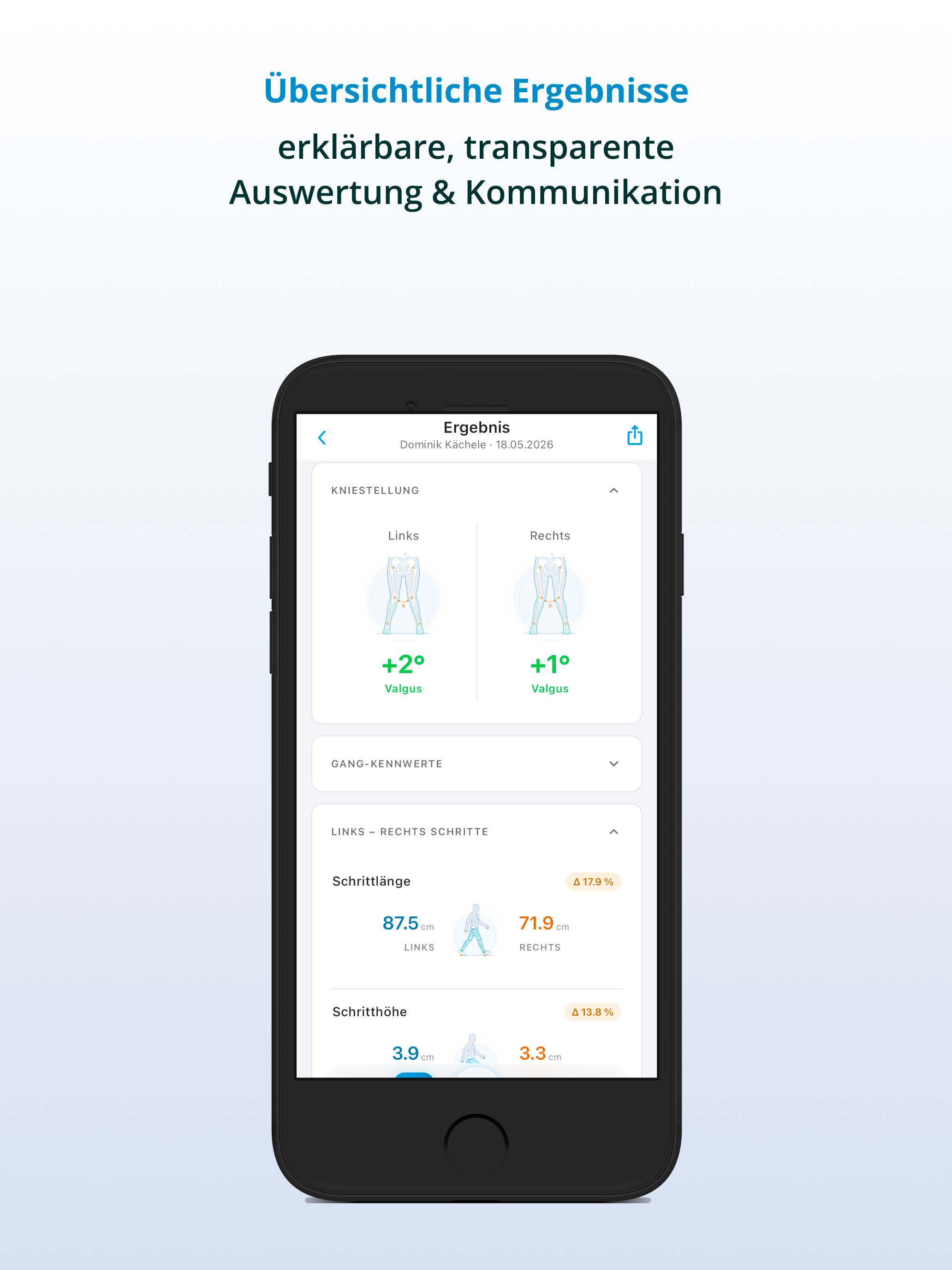
The checklist works best when there is one measured record that every score refers to. That is what objective motion analysis adds. One smartphone video of the patient standing up, walking and turning gives measured gait and mobility data, such as walking speed and step length, without wearables, mats or a gait lab. Nurse and therapist code from the same recorded performance, and the record carries the evidence behind each score.
The clinician still makes every coding decision. Objective measurement does not replace clinical judgment; it gives that judgment a shared, documented basis. LINDERA's video-based gait analysis has been validated against the GAITRite walkway (ICC 0.982, published in Scientific Reports) and is used in 600+ care sites in Europe, where it is a CE-marked medical device.
LINDERA US brings this workflow to US home health teams and is currently in pilot with US therapy teams. If OASIS and GG consistency is costing your agency time or payment, book a 20-minute walkthrough and we will look at it against your own numbers. To see how it fits home health, visit our Home Health page.
No. They use different definitions and scales: M items rate ability to perform an activity safely, GG items rate usual performance. They should not contradict each other without explanation. When they differ, the record should show why.
The functional impairment level is calculated from M1800 Grooming, M1810 and M1820 Dressing, M1830 Bathing, M1840 Toilet transferring, M1850 Transferring, M1860 Ambulation/locomotion and M1033 Risk for hospitalization. The GG items feed quality measures, including the Discharge Function Score.
An OASIS-based quality measure that compares a patient's discharge GG self-care and mobility scores with a risk-adjusted expected score. It is part of the Home Health Quality Reporting Program and of the expanded Home Health Value-Based Purchasing Model.
The clinician who completes the assessment. Technology can measure and document performance and flag contradictions, but every OASIS response is the clinician's decision.
No. It gives nurses and therapists one shared, documented record of what the patient did, so their judgments start from the same evidence.