
Blog
AI
AI Gait Analysis for DME Documentation in US Home Health and Assisted Living: What's Validated, What's Coming, and How to Be in the LMotionLab US Pilot

Diana Heinrichs
AI Gait Analysis for DME Documentation in US Home Health and Assisted Living: What's Validated, What's Coming, and How to Be in the LMotionLab US Pilot
11:39
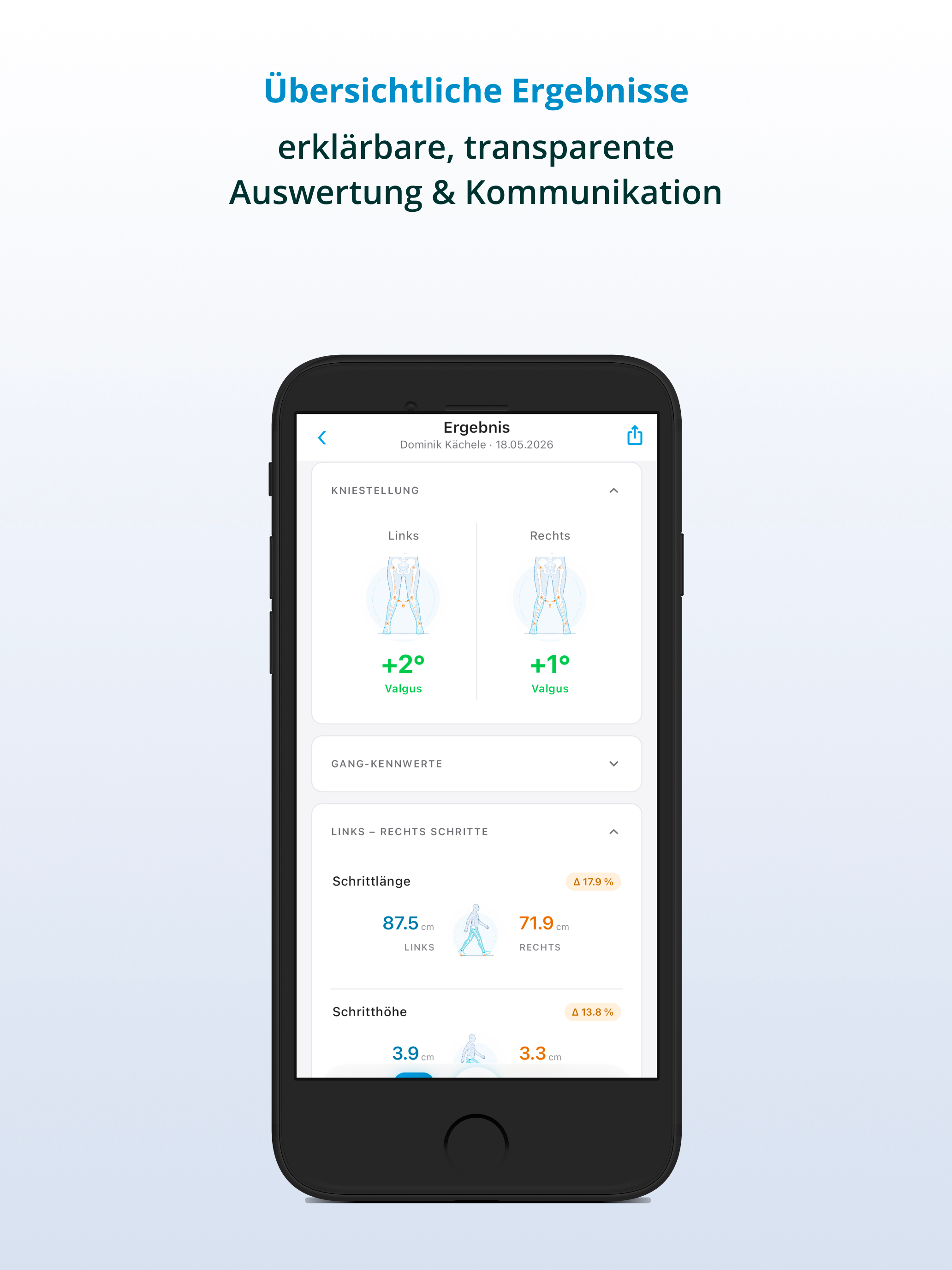
LMotionLab — LINDERA's AI-based gait analysis app for the orthotic and therapy supply chain — went live in the German Apple App Store this week. The US-native version, built for HIPAA-aligned deployment and the workflow of American home health and assisted living physical therapy, arrives this summer.
This post is for US physical therapists, therapy directors, home health agencies, and DME-adjacent provider organizations who want to understand the technology before it lands in their App Store, and who want to be in the structured US pilot cohort we are recruiting now.
Three claims up front. Each is the kind of statement I will spend the rest of this post defending:
- AI-based gait analysis from a single frontal iPhone recording is a peer-reviewed, validated method. Not an emerging idea. A published one.
- The dominant cause of DME claim denials for knee unloader bracing is a documentation gap, not a clinical-fit gap. That gap is exactly what LMotionLab was engineered to close.
- The "where is the lateral camera?" question — which every well-trained PT and biomechanist asks on first contact — is the wrong question for AI-based gait analysis. It is the right question for sensor and multi-camera systems. The two methods are not the same thing.
If those three claims sound load-bearing, that is the point. They are the spine of why I think this technology category will reshape DME documentation in US home health and assisted living over the next twenty-four months, and why we are running a focused pilot before broader rollout.
What just happened: the German launch, OT World Leipzig, and the recurring US question
LMotionLab launched in the German Apple App Store this week. We co-developed it with the Sanitätshaus Aktuell AG — a federation of German orthotic and prosthetic suppliers — and our delivery partners Kächele and Carqueville. The first commercial use case is objective documentation in the supply chain for knee unloader braces in patients with symptomatic knee osteoarthritis. Same clinical territory as US medial and lateral compartment OA. Different reimbursement system. Same underlying documentation problem.
Last week at OT World in Leipzig — the largest international meeting for orthotic, prosthetic, and rehabilitation technology — we spent five days in front of orthotic clinicians, rehab physicians, and a steady flow of US visitors. The most consistent inbound conversation came from US-based physical therapists, therapy directors at home-health and assisted-living chains, and DME provider executives. The question was always the same: when does this hit the US, and what does it do for our denial rate?
This post answers both.
The documentation problem US home health and assisted living PT is quietly carrying
In US home health, assisted living, and skilled nursing settings, the PT documentation burden has shifted. Functional outcome measures are not optional. Medical necessity has to be defensible. DME prescriptions — particularly knee unloader bracing for varus-aligned medial-compartment or valgus-aligned lateral-compartment knee osteoarthritis — depend on documentation that an auditor will accept months after the brace is delivered and the claim is paid.
When the documentation is subjective ("antalgic gait, mild varus thrust"), denial risk and audit-recoupment risk rise. When the documentation is objective and quantified, both fall. The challenge has never been that PTs do not know this. The challenge is that the tools to generate objective gait kinematics — instrumented gait labs, marker-based motion capture, force plates — do not fit in a home-health visit and are not parked in the corner of an assisted living facility.
The market has been asking, in essence: give us the gait lab in the iPhone the PT is already carrying.
That is what LMotionLab is.
What LMotionLab is — and what it is not
LMotionLab is not a sensor system. It is not a multi-camera rig. It is not a wearable.
LMotionLab is an AI model that reconstructs three-dimensional gait parameters from a single frontal 2D recording captured on a standard iPhone. Stride length, cadence, step width, stance time, gait symmetry, gait stability — and, critical for DME documentation, frontal-plane knee alignment, including dynamic varus and valgus deviation during gait.
The clinical question this is built to answer: did the patient's gait and knee alignment change between intake, post-brace fitting, and follow-up? Quantitatively. Reproducibly. On site.
"Where is the sagittal view?" — and why that is the wrong question for AI-based gait analysis
Every well-trained PT and biomechanist will ask some version of the same question. So did the orthotists, the rehab physicians, and the neurologists at OT World last week:
Where is the lateral camera?
The instinct is correct for sensor-based systems and multi-camera motion capture. Sagittal-plane kinematics are most directly observable from a lateral view. In classical biomechanics, that is where you place the camera.
It is the wrong question for AI-based gait analysis.
LMotionLab's model was not trained to imitate a lateral camera. It was trained to infer the biomechanical parameters — including those most clearly seen in the sagittal plane — from frontal-view input. A neural network does not learn what a camera physically "sees." It learns the relationship between observable movement patterns and the underlying biomechanical quantities that produce them.
The analogy I have been using on stage: it is the equivalent of refusing to draw blood from the left arm because "the values from the right arm are the validated ones." The measurement modality, not the anatomical convention, defines what is observable.
This is not a debate about which method is "more rigorous." It is a recognition that two different technology classes produce the same clinically useful output through different physical inputs.
The scientific basis: validated with Charité – Universitätsmedizin Berlin, published in Nature Portfolio
This is not a claim we make. It is a finding we have published.
In partnership with Charité – Universitätsmedizin Berlin, one of Europe's largest academic medical centers, we validated AI-based smartphone gait analysis against the clinical gold standard — instrumented 3D motion capture in a biomechanics laboratory. The study is open access:
→ Smartphone-based gait analysis — Scientific Reports (Nature Portfolio), 2021
The core finding: the gait parameters reconstructed by AI from a single 2D recording show clinically meaningful agreement with laboratory 3D motion capture. That is the validated foundation under LMotionLab.
For PTs and therapy directors, this matters in one specific way. The documentation generated by LMotionLab is not a clinician-rated estimate. It is a model-derived measurement with a peer-reviewed validation pathway behind it. That is what payers, auditors, and accrediting bodies look for when they evaluate whether the data in a documentation chain is defensible.
DME documentation and denial defense: the commercial reality
Knee unloader braces sit in a DME category where Medicare, Medicare Advantage, and commercial payers consistently scrutinize medical necessity. The most common drivers of denial and downstream audit recoupment in this category are not clinical misfit — they are documentation gaps. Specifically: absent or non-objective measurement of malalignment at intake, no quantified pre-brace functional assessment, and no follow-up measurement demonstrating response to therapy.
LMotionLab is built to close those three gaps:
- Objective frontal-plane alignment measurement at intake, captured in the home or facility, time-stamped, exportable.
- Quantified gait parameters that sit alongside standard PT outcome measures (TUG, 10-meter walk, Berg) and add the kinematic data a payer auditor can actually inspect.
- Reproducible follow-up measurement at predefined intervals — the documentation that converts a one-time DME claim into a defensible, longitudinally documented course of therapy.
We are not telling therapy groups that LMotionLab eliminates denials. No tool does that, and we will not pretend otherwise. We are saying that the documentation gap responsible for a large share of denials in knee DME is the specific gap LMotionLab was engineered to close.
Workflow fit for US home health and assisted living
The constraint that defines PT in these settings is time on site. Minutes per patient matter. Equipment that does not fit in a clinician's bag does not get used.
LMotionLab runs on the iPhone the PT is already carrying. A patient recording takes the duration of a clinical walk test on a flat surface available in most home and ALF environments. Output is generated on device, synced to the clinician's account, and exportable for chart documentation.
For therapy groups running fall-risk programs under CMS quality reporting, the same gait data feeds directly into fall-risk stratification. Gait is the strongest single behavioral predictor of fall risk in older adults — that is the literature LINDERA was founded on. The knee OA and DME documentation use case is the first US commercial entry point. The underlying technology covers the broader functional mobility picture, including post-stroke, Parkinsonian, and post-orthopedic rehabilitation gait.
The US rollout timeline
This is the part most US readers want directly.
- Now (May 2026): LMotionLab is live in the German Apple App Store. The US-facing pilot interest list is open. Charité-validated technology is in commercial use in Europe with our orthotic-supply partners.
- Summer 2026: US-native version of LMotionLab. HIPAA-aligned deployment, BAA framework, US hosting region, US English UI. We are not porting a European app into the US App Store. We are shipping a US-native build for US workflows.
- Q3 2026: Structured pilots with a focused cohort of US therapy groups and home health agencies. Cohort size deliberately limited so the LINDERA clinical and engineering team can support each pilot directly.
- Q4 2026 and beyond: Broader US availability, with workflow integrations into the EHR and outcomes-tracking systems the pilot cohort surfaces as priority.
We are starting where the evidence is strongest and the documentation pressure is highest: knee OA bracing pathways in home health and assisted living. The product is broader. The launch is focused.
Who the US pilot is for
The pilot cohort is intentionally narrow. We are recruiting:
- Home health agencies with active PT staff and DME referral pathways for knee unloader bracing.
- Assisted living organizations with in-house or contracted therapy services and an interest in objective functional documentation.
- Therapy contract groups serving SNF, ALF, or home-health populations who manage documentation across multiple sites and want to reduce per-claim documentation drag.
- DME provider organizations with PT-led prescribing or documentation workflows for knee bracing.
If your organization fits one of those profiles and you want to evaluate LMotionLab against your own denial rate, audit exposure, and PT documentation burden — we want to talk before US App Store launch, not after.
Is LMotionLab available in the US App Store today?
Not yet. LMotionLab is live in the German Apple App Store as of May 2026. The US-native version, with HIPAA-aligned deployment and US English UI, arrives this summer. The US-facing pilot interest list is open now.
Is LMotionLab a medical device?
No. LMotionLab is a measurement instrument, not a medical device. It captures gait and provides objective frontal-plane data — including dynamic varus and valgus alignment — that the clinician then interprets. LMotionLab does not diagnose, does not treat, and does not make clinical recommendations. The interpretive layer stays with the PT or prescribing clinician.
Can LMotionLab measure valgus and varus alignment?
Yes. Frontal-plane knee alignment, including dynamic varus and valgus deviation during gait, is part of the standard output set. This is among the parameters most directly relevant to unloader brace prescription and the documentation that supports it.
Does using LMotionLab guarantee fewer DME denials?
No tool guarantees that, and we will not claim it. What LMotionLab does is close the specific documentation gap — objective alignment measurement, quantified functional outcomes, reproducible follow-up — that drives a large share of denials in knee DME. The pilot cohort will measure the operational impact directly.
How long does a single gait recording take?
A standard gait recording takes the time of a clinical walk test. Patient setup is minimal. The patient walks toward the smartphone or tablet camera on a flat surface available in most home or facility settings.
Is the underlying technology peer-reviewed?
Yes. Validation of AI-based smartphone gait analysis against instrumented 3D motion capture was conducted in collaboration with Charité – Universitätsmedizin Berlin and published in Scientific Reports (Nature Portfolio), 2021. LINDERA has additional clinical research underway in fall risk and post-orthopedic rehabilitation.
Why launch in Germany first?
Two reasons. First, our co-development partnership with the German orthotic supply network — Sanitätshaus Aktuell AG, Kächele, Carqueville — created the right pilot environment with directly aligned clinical and commercial incentives. Second, the US version is not a German app with a translated UI. It is a US-native build with HIPAA-aligned infrastructure, US hosting, and a workflow tuned for American home health and assisted living PT documentation. That build is on track for this summer.
How do I get into the pilot?
Contact LINDERA directly. Pilot slots through Q3 2026 are deliberately limited. We respond inside one business week.
How to be in the LMotionLab US Pilot
LMotionLab arrives in the US App Store this summer. The pilot cohort is being recruited now. If your home health agency, assisted living organization, therapy contract group, or DME provider operation wants to be in the cohort that helps shape US deployment — and that measures denial-rate impact directly — reach out to LINDERA:
US pilot inquiries: lmotionlab@lindera.de